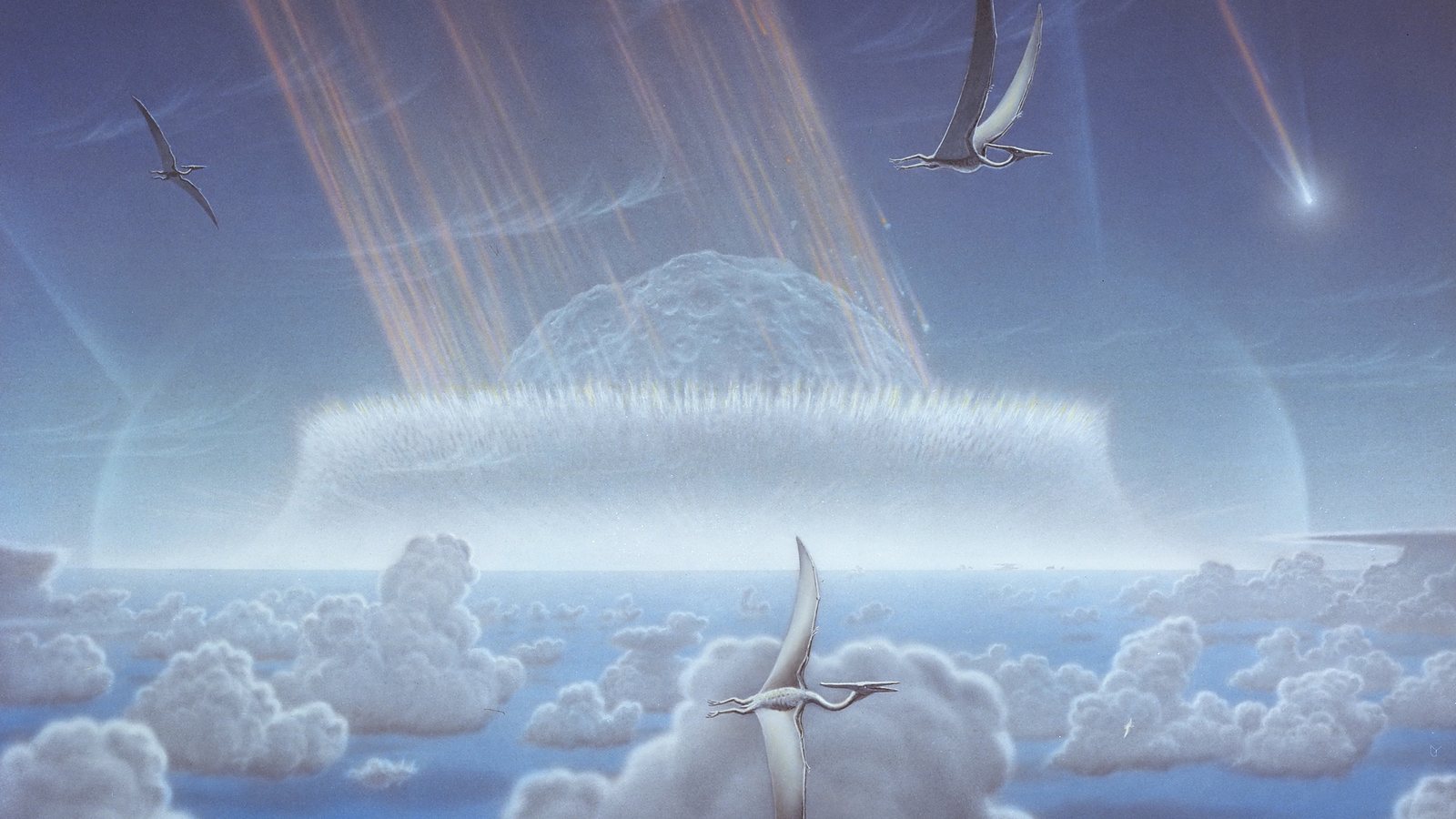
66 million years ago, an asteroid about ten kilometres across struck the Yucatán Peninsula in Mexico, digging the Chicxulub crater, some 180 km wide. The impact triggered a global climate upheaval that wiped out the non-avian dinosaurs and about three quarters of living species.
It is probably the most famous meteorite fall in Earth’s history, and one of the great scientific investigations of the 20th century. For a long time, the disappearance of the dinosaurs remained a mystery. Here is how researchers solved it, step by step, and what is still debated.
66 million years ago
At the end of the Cretaceous, dinosaurs had populated the Earth for more than 160 million years. Then, in the blink of a geological eye, they vanished, along with ammonites, the great marine reptiles and much of the plankton. In the rocks, this boundary shows up as a thin layer of clay: the Cretaceous-Paleogene boundary.
The iridium clue
In 1980, the physicist Luis Alvarez and his son, the geologist Walter Alvarez, published an astonishing finding: this clay layer, studied in particular near Gubbio in Italy, contains far too much iridium. This metal is very rare in the Earth’s crust but abundant in meteorites. Their hypothesis: a large asteroid hit the Earth, and its dust settled over the whole planet. The iridium anomaly would later be found all over the world.
The crater found
The crater still had to be found. Geophysicists from the Mexican state oil company had spotted, as early as the late 1970s, a huge circular structure buried beneath the Yucatán. In 1991, researchers showed that it was the crater they were looking for: Chicxulub, named after a village near its centre. About 180 km wide, it is now covered by hundreds of metres of sediment. Other clues converge: quartz grains “shocked” by extreme pressures, glass beads thrown out by the impact, tsunami deposits around the Gulf of Mexico.
The hours, days and years that followed
The first minutes: a fireball, a colossal earthquake, giant tsunamis in the Gulf of Mexico.
The first hours: red-hot debris rains down over the whole planet; fires break out on several continents.
The following months and years: dust, soot and above all sulphur aerosols, released by the gypsum-rich rocks of the Yucatán, darken the sky. Photosynthesis collapses and temperatures plunge: this is the “impact winter”.
Drilling carried out in 2016 at the heart of the crater also showed that life returned there within just a few years, proof of life’s resilience.
What kind of asteroid?
The object was about ten kilometres across. In 2024, a team analysed the isotopic composition of ruthenium, a metal brought by the asteroid, in the Cretaceous-Paleogene boundary layer. Its signature matches that of carbonaceous chondrites, suggesting an asteroid from the outer regions of the Solar System, beyond Jupiter. We present this family of meteorites in our article on chondrites.
What about the Deccan volcanoes?
At the same time, immense eruptions covered part of India in lava: the Deccan Traps. They probably weakened ecosystems and altered the climate. The debate over their share of responsibility long divided researchers; today, most agree that the Chicxulub impact was the main cause of the extinction, with the volcanoes possibly worsening the crisis.
Did all the dinosaurs disappear?
Not quite: birds are descended from dinosaurs, and they are the only ones that survived. Palaeontologists therefore speak of the extinction of the “non-avian” dinosaurs. The disappearance of the great reptiles then left the field open to mammals, of whom we are the distant heirs.
Could such an impact happen again?
An asteroid of this size strikes the Earth only at intervals of the order of a hundred million years. Survey programmes have now located the vast majority of asteroids larger than a kilometre that cross Earth’s orbit, and none threatens the Earth in the coming century. Small objects remain harder to detect, as the Chelyabinsk event in 2013 showed. And since the DART mission in 2022, we know it is possible to deflect a small asteroid.
Older than the dinosaurs
You cannot own a piece of the Chicxulub asteroid: it was almost entirely vaporised by the impact. But the meteorites found today are much older than the dinosaurs: they formed 4.5 billion years ago, at the same time as the Solar System. Read our article how old are meteorites?
Frequently asked questions
Which meteorite wiped out the dinosaurs?
An asteroid about ten kilometres across, which struck the Yucatán 66 million years ago and dug the Chicxulub crater. 2024 analyses suggest it was a carbonaceous chondrite-type asteroid.
Where is the Chicxulub crater?
On the Yucatán Peninsula in Mexico, partly under the sea. It is buried beneath hundreds of metres of sediment and cannot be seen at the surface.
Why was the impact so destructive?
Because it threw huge amounts of dust, soot and sulphur aerosols into the atmosphere, which darkened the sky and cooled the planet for years, causing food chains to collapse.
Can you buy a piece of the dinosaur meteorite?
No: the asteroid was almost entirely vaporised on impact. Any listing claiming to sell a fragment of it should be avoided.
66 million years ago, an asteroid about ten kilometres across struck the Yucatán Peninsula in Mexico, digging the Chicxulub crater, some 180 km wide. The impact triggered a global climate upheaval that wiped out the non-avian dinosaurs and about three quarters of living species.
The largest meteorite in the world is Hoba, in Namibia: a block of iron weighing more than 60 tonnes, discovered in 1920 and never moved since. Next come Ahnighito (Cape York, Greenland, nearly 31 tonnes), two blocks of Campo del Cielo in Argentina (30.8 and 28.8 tonnes) and Armanty, a fragment of the Chinese Aletai meteorite (28 tonnes).
To start a meteorite collection, choose a theme (main families, famous falls, French meteorites, the Moon and Mars), begin with named, affordable pieces such as Campo del Cielo or a Saharan chondrite, keep every certificate and store your pieces dry and carefully labelled.
To provide the best possible experience, we use technologies such as cookies to store and/or access information on devices. Consent to these technologies will enable us to process data such as browsing behaviour or unique identifiers on this website. Failure to give consent, or withdrawal of consent, may adversely affect certain features and functions.
Functional
Always active
Storage or technical access is strictly necessary for the legitimate interest of enabling the use of a specific service explicitly requested by the subscriber or user, or for the sole purpose of transmitting a communication over an electronic communications network.
Preferences
Storage or technical access is necessary for the legitimate interest of storing preferences that are not requested by the subscriber or user.
Stats
Storage or technical access used exclusively for statistical purposes. Storage or technical access used exclusively for anonymous statistical purposes. In the absence of a court order, voluntary cooperation from your internet service provider or additional records from a third party, information stored or retrieved for this purpose alone cannot generally be used to identify you.
Marketing
Storage or technical access is required to create user profiles for the purpose of sending adverts, or to track the user across a website or across several websites with similar marketing purposes.