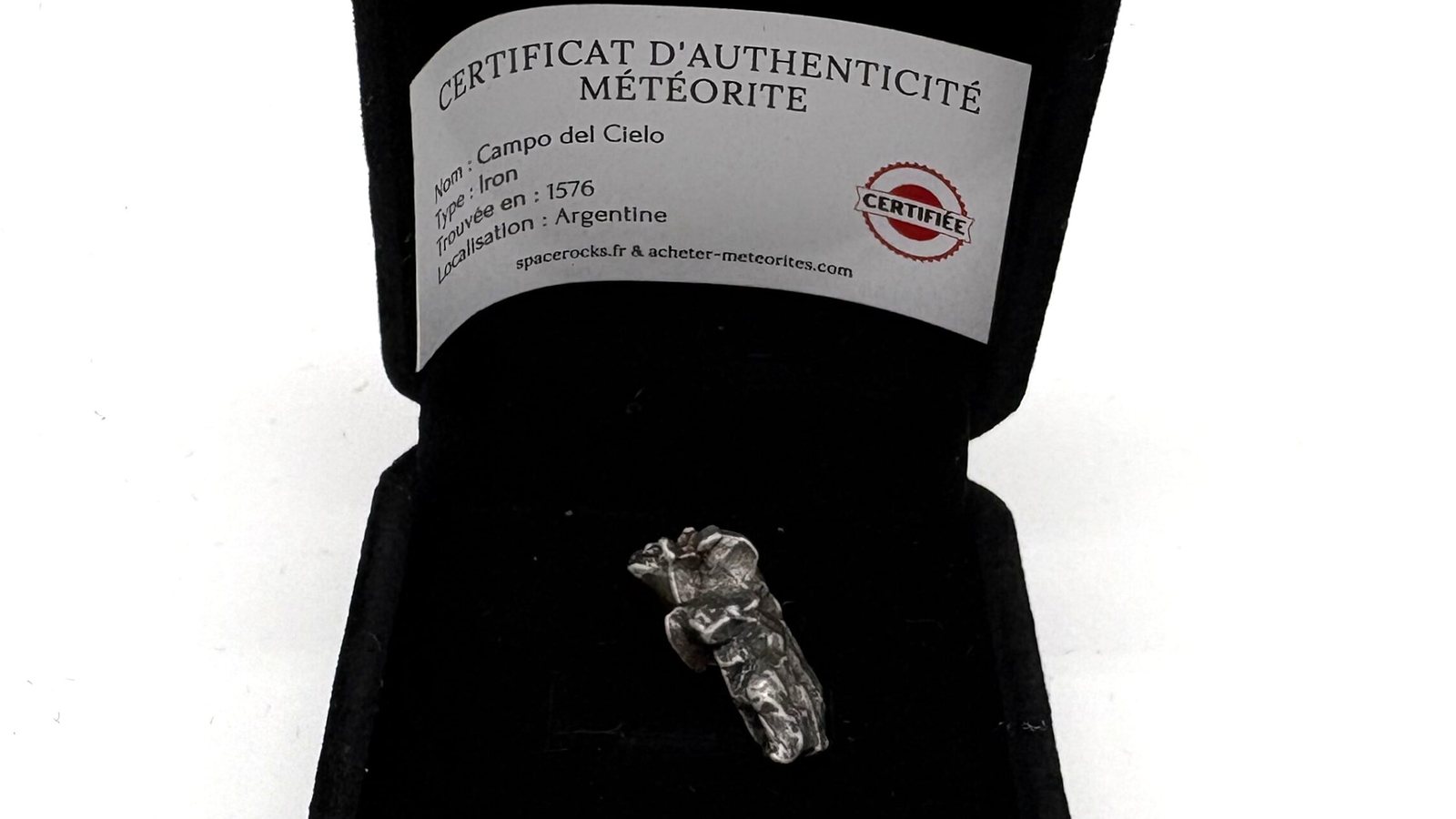
An iron meteorite, or siderite, is a fragment of the metallic core of an ancient asteroid, made of an iron-nickel alloy. It accounts for only about 5% of observed falls, but a large share of the meteorites found: it withstands time well and is easy to notice, because it is heavy and attracted by a magnet.
Campo del Cielo, Aletai, Muonionalusta, Gebel Kamil, Saint-Aubin: the meteorites most used in jewellery and decoration are almost all iron meteorites. Their metallic sheen and geometric patterns fascinate, but their real interest lies elsewhere: they are pieces of the cores of vanished worlds.
Where do iron meteorites come from?
4.5 billion years ago, the first small bodies of the Solar System heated up, notably through short-lived radioactive elements. In the largest of them, the rock melted: the denser metal sank to the centre to form a core, while the silicates stayed near the surface. These are called differentiated asteroids, built like miniature planets.
Collisions later shattered several of these asteroids. Their cores, broken into fragments, scattered through space. When one of them crosses Earth’s path, it falls as an iron meteorite. Holding a siderite means holding a piece of the core of a celestial body that no longer exists.
What are they made of?
Mainly two iron-nickel alloys, kamacite (low in nickel) and taenite (rich in nickel), with inclusions of iron sulphide (troilite), phosphide (schreibersite) and sometimes graphite. Nickel content ranges from 5 to over 25% depending on the meteorite. Their density, close to 7.8, far exceeds that of common terrestrial rocks, around 2.7.
Three families based on their structure
Family
Nickel
What you see after polishing and acid etching
Examples
Hexahedrites
below about 6%
Fine parallel lines, called Neumann lines
Rarer
Octahedrites
about 6 to 13%
Widmanstätten patterns, a network of criss-crossing bands
Campo del Cielo, Aletai, Muonionalusta, Gibeon, Saint-Aubin
Ataxites
above about 16%
No structure visible to the naked eye
Gebel Kamil, Hoba
The width of the bands in octahedrites depends on the nickel content and on how fast the core cooled: from a few degrees to a few tens of degrees per million years. We explain this phenomenon in detail in our article on Widmanstätten patterns.
Chemical groups: one group, one asteroid
Beyond their structure, iron meteorites are classified into chemical groups (IAB, IIAB, IIIAB, IVA, IVB…) according to their content of nickel, gallium, germanium or iridium. Each group corresponds, in principle, to the same parent body. More than a thousand iron meteorites are known, coming from several dozen different asteroids.
Campo del Cielo belongs to group IAB;
Saint-Aubin, the most massive meteorite found in France, to group IIIAB;
Muonionalusta and Gibeon to group IVA;
Aletai to a rare variant of group IIIE;
Gebel Kamil fits no group: it is said to be “ungrouped”.
Famous iron meteorites
Hoba (Namibia): over 60 tonnes, the largest known meteorite, never moved since its discovery in 1920.
Campo del Cielo (Argentina): a field of craters and blocks of nearly 30 tonnes; read its story.
Aletai (China): a 28-tonne block and fragments scattered over more than 400 km; see our article on the Aletai meteorite.
Sikhote-Alin (Russia): a fall observed on 12 February 1947, which covered the taiga with thousands of fragments.
Muonionalusta (Sweden): on Earth for more than 800,000 years; discover it in our article on Muonionalusta.
Gebel Kamil (Egypt): it dug a 45-metre crater; its story is here.
For the full ranking of the giants, read our article on the largest meteorites in the world.
How to recognise an iron meteorite
The weight: it feels unusually heavy for its size.
The magnet: it is strongly attracted.
The surface: rounded hollows like thumbprints (regmaglypts), a dark crust or a rusty patina.
The inside: shiny metal once filed, and often Widmanstätten patterns after acid etching.
The nickel: a simple chemical test reveals its presence, which is absent from most man-made iron.
Industrial slag, often mistaken for meteorites, is frequently bubbly and contains no nickel. All the details are in our article on recognising a real meteorite.
Rust, the weak point of iron meteorites
Rich in iron, siderites oxidise on contact with moisture, all the more so because they sometimes contain chlorides that speed up corrosion. A collection piece should be kept dry, ideally with a desiccant sachet, and protected with a thin layer of oil or wax. For jewellery, follow our guide to caring for meteorite jewellery.
Frequently asked questions
Why are iron meteorites so heavy?
Because they are made of metal: their density is around 7.8, nearly three times that of an ordinary terrestrial rock.
Are all meteorites made of iron?
No. Iron meteorites account for only about 5% of observed falls. The vast majority are stony meteorites, mostly chondrites.
Can an iron meteorite rust?
Yes. In contact with moisture, it becomes covered in rust. Kept dry and protected with a thin layer of oil or wax, it remains stable for decades.
What is the largest known iron meteorite?
Hoba, in Namibia: over 60 tonnes in a single block. It has never been moved since its discovery in 1920.
An iron meteorite, or siderite, is a fragment of the metallic core of an ancient asteroid, made of an iron-nickel alloy. It accounts for only about 5% of observed falls, but a large share of the meteorites found: it withstands time well and is easy to notice, because it is heavy and attracted by a magnet.
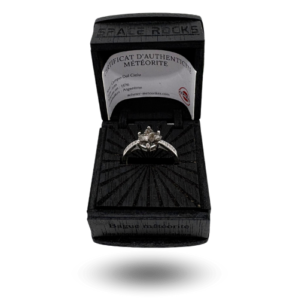
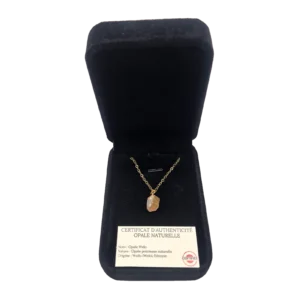
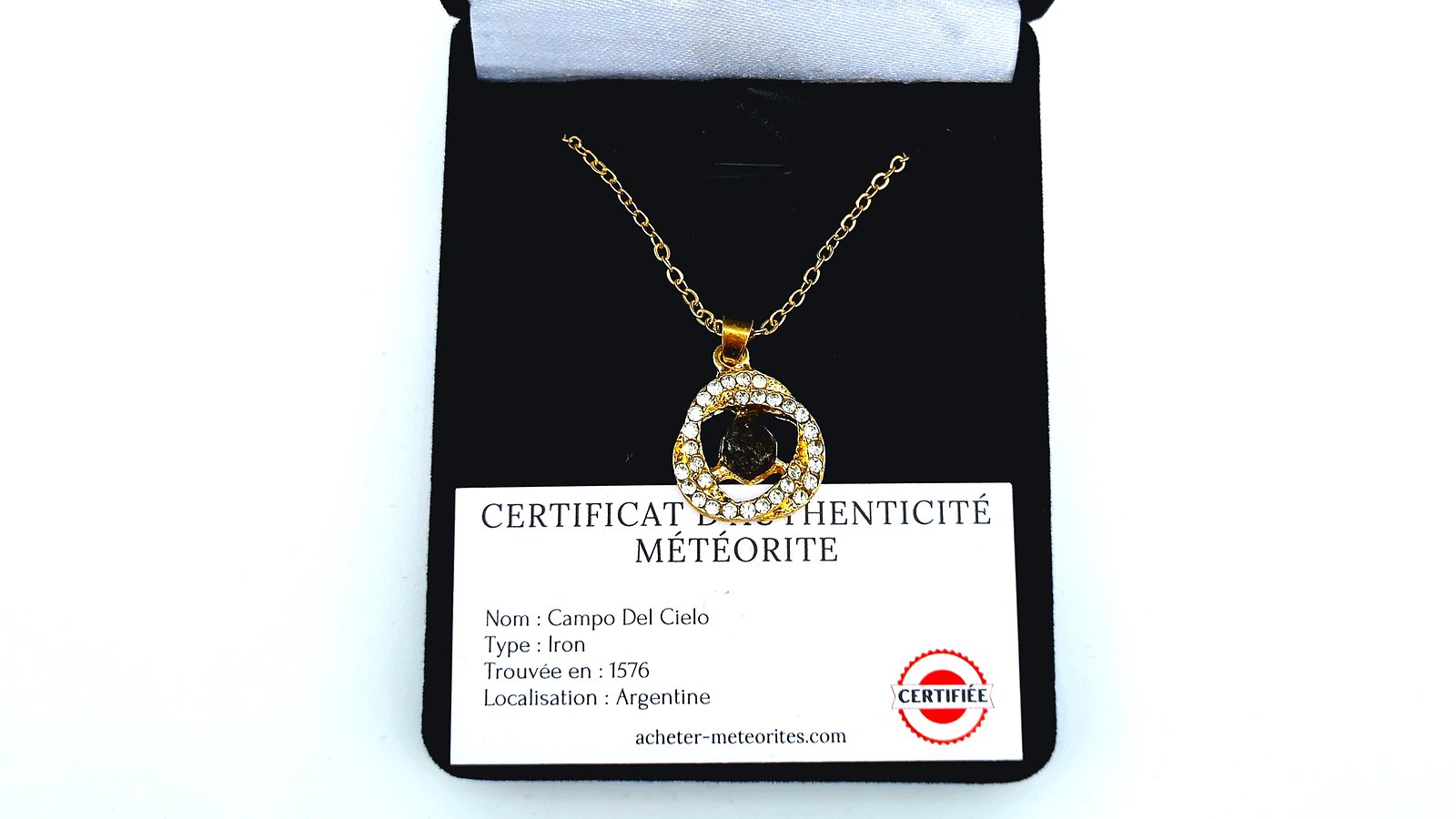
The most popular meteorite jewelry for women is the teardrop or heart pendant, the gold-tone cage necklace, the fine ring and hoop earrings. Most pieces cost between €55 and €80, and around €150 for jewelry set with lunar meteorite. Every fragment is unique, so no two pieces are identical, and each one comes with its certificate.
A "meteorite" piece of jewellery sold for a few euros is almost always fake: dyed stone, metal etched to imitate Widmanstätten patterns, or a mere "meteorite effect". To be sure of your purchase, insist on the official name of the meteorite, a certificate that repeats it and an identified seller, and be wary of prices that are too low.
To provide the best possible experience, we use technologies such as cookies to store and/or access information on devices. Consent to these technologies will enable us to process data such as browsing behaviour or unique identifiers on this website. Failure to give consent, or withdrawal of consent, may adversely affect certain features and functions.
Functional
Always active
Storage or technical access is strictly necessary for the legitimate interest of enabling the use of a specific service explicitly requested by the subscriber or user, or for the sole purpose of transmitting a communication over an electronic communications network.
Preferences
Storage or technical access is necessary for the legitimate interest of storing preferences that are not requested by the subscriber or user.
Stats
Storage or technical access used exclusively for statistical purposes. Storage or technical access used exclusively for anonymous statistical purposes. In the absence of a court order, voluntary cooperation from your internet service provider or additional records from a third party, information stored or retrieved for this purpose alone cannot generally be used to identify you.
Marketing
Storage or technical access is required to create user profiles for the purpose of sending adverts, or to track the user across a website or across several websites with similar marketing purposes.